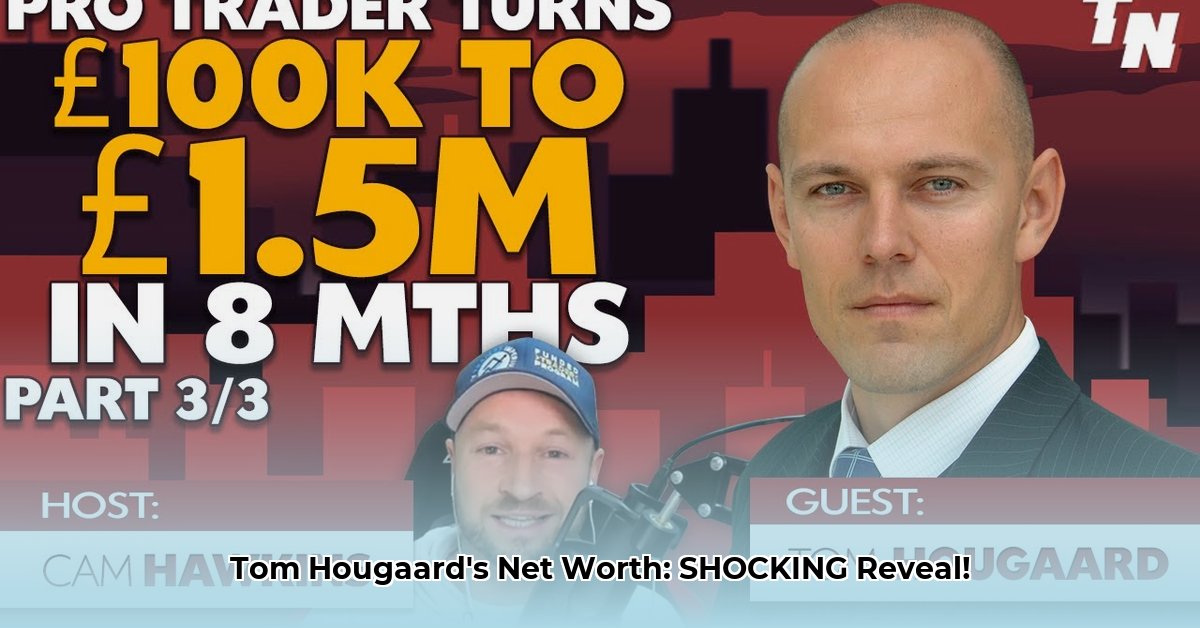
Tom Hougaard Net Worth: Unraveling the Mystery
Determining the precise net worth of Tom Hougaard, a prominent figure in the world of high-frequency trading (HFT) and online trading education, presents a significant challenge. Publicly available information is scarce, leading to widely disparate estimates ranging from a few million dollars to a reported $1.2 billion. This discrepancy highlights the inherent difficulties in assessing the wealth of private individuals, particularly those involved in highly volatile and opaque financial markets. How can we possibly reconcile such vastly different figures? For comparison, see similar net worth analysis.
The Wildly Different Estimates: A Tale of Two Numbers
The substantial variation in reported net worth figures stems from the complexities of evaluating wealth generated through HFT. One source attributes his wealth to his alleged stake in Saxo Bank's success, suggesting a potential billion-dollar fortune. Conversely, other estimates, often based on assessments of his trading performance alone, are significantly lower. This lack of consensus underscores the limitations of readily available data. Is there a way to approach this puzzle more systematically?
Why is it So Hard to Pin Down His Wealth?
Several factors contribute to the difficulty in accurately determining Tom Hougaard's net worth:
Volatility of Trading Profits: Unlike salaried employment, a trader's wealth fluctuates dramatically based on market conditions. Profits are not guaranteed, making any fixed valuation inherently unstable. It’s a dynamic landscape where today’s gains could vanish tomorrow.
Illiquidity of Assets: Traders often hold assets that are not easily converted into cash, such as private investments or less liquid securities. These assets lack readily available market valuations, complicating accurate assessment.
Privacy and Confidentiality: Private individuals, especially those in high finance, have no legal obligation to publicly disclose their financial details. This lack of transparency makes any form of independent verification extremely challenging.
Diversified Income Streams: Hougaard's wealth isn't solely derived from trading. His extensive educational ventures, books, and courses contribute significantly to his overall financial picture. Estimating his total cumulative income necessitates evaluating these multiple income streams.
Dissecting the Business Empire: Beyond Trading Profits
To understand the complexity, we must consider the multifaceted nature of Hougaard's financial empire. His co-founding role at Saxo Bank significantly shapes his net worth, as does the value of his stake in the company. Equally important is his prominence in the online financial education industry, generating considerable revenue from courses and educational materials. These elements must be integrated for a comprehensive assessment.
What the Discrepancies Teach Us
The wide disparity in estimates serves as a cautionary tale. It highlights the prevalence of unreliable information online and the limitations of relying on unverified sources when evaluating the financial status of private individuals. The lack of transparency underscores the need for a critical and analytical approach to such information.
The Big Unknowns: The Path Forward
Achieving a more accurate assessment requires greater transparency. Access to verified financial documents regarding his Saxo Bank holdings, his personal investment portfolio, and the financial performance of his educational initiatives would be crucial. Without such transparency, any attempt to pinpoint his net worth remains speculative.
A Final Thought: The Broader Implications
The challenges in estimating Tom Hougaard's net worth illustrate wider issues surrounding transparency in finance and the difficulties in evaluating wealth in complex and dynamic fields. This case highlights the importance of critical thinking and the limits of relying on readily available, but potentially unreliable, data.
How to Accurately Assess the Net Worth of Private High-Frequency Traders
Key Takeaways:
- Assessing the net worth of private high-frequency traders (HFTs) is exceptionally challenging due to the opacity of their trading strategies and the complex nature of their assets.
- Public records offer little insight into HFTs' financial holdings; traditional methods are ineffective.
- Understanding the intricacies of HFT algorithms and profit margins is crucial for any estimation, requiring specialized financial expertise.
- Indirect methods, such as analyzing market impact and inferring profits from trading volume, can provide partial, albeit speculative, estimates.
- The lack of transparency surrounding HFT operations makes accurate net worth estimations exceptionally difficult.
The inherent difficulty in assessing the wealth of private HFTs stems from the secrecy surrounding their operations and the complexities of their trading strategies. Unlike publicly traded companies, HFTs don't generally release financial information, making traditional methods of valuation impractical. How, then, can we even attempt to approximate these figures? The answer lies in indirect methods, but even those have significant limitations.